Most people know that interest earned on savings is technically taxable income, but far fewer realise that there are several allowances that can protect a significant amount of that interest from tax entirely. If you have savings accounts, cash ISAs, or fixed-rate bonds, it is worth understanding exactly what you are entitled to before assuming you have a tax problem.
Quick Answer: How Much Savings Interest Is Tax-Free?
Most basic rate taxpayers can earn up to £1,000 in savings interest tax-free each year under the Personal Savings Allowance. Higher rate taxpayers have a £500 allowance. Additional rate taxpayers have no Personal Savings Allowance. On top of this, interest earned inside a Cash ISA is always tax-free and does not count towards the allowance.
The Personal Savings Allowance
The Personal Savings Allowance (PSA) was introduced in April 2016 and applies to interest from most savings accounts, current accounts, corporate bonds, and government gilts.
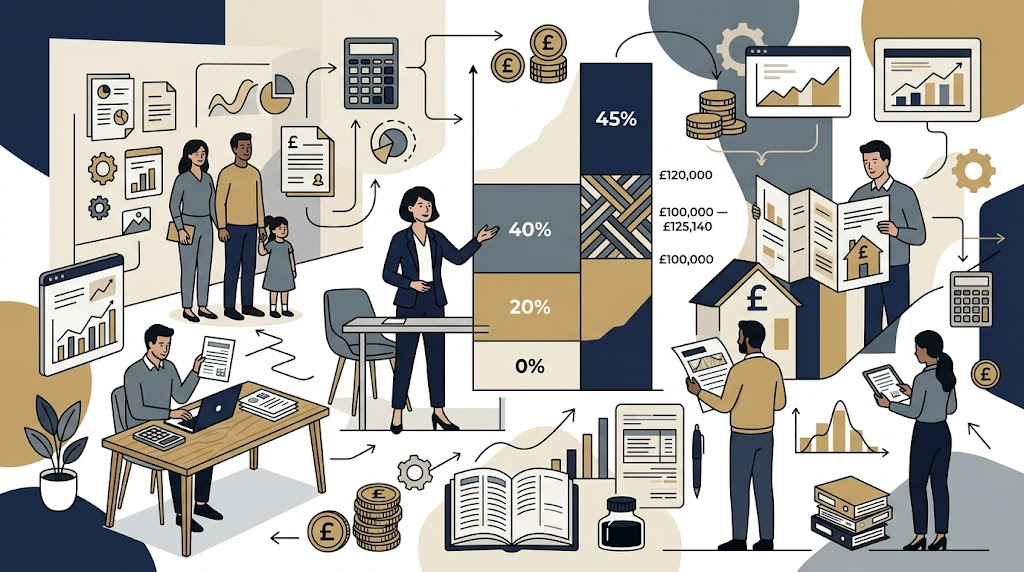
The allowance depends on your Income Tax band:
| Tax Band | Personal Savings Allowance |
|---|---|
| Basic rate (20%) | £1,000 |
| Higher rate (40%) | £500 |
| Additional rate (45%) | Nil |
If your total savings interest is below your allowance, you pay no tax on it and do not normally need to do anything. If it exceeds your allowance, the excess is taxable at your marginal rate.
Cash ISAs: Always Tax-Free
Interest earned inside a Cash ISA does not count towards your Personal Savings Allowance and is never subject to Income Tax. The annual ISA allowance for the 2026/27 tax year is £20,000. You can split this across different types of ISA (cash, stocks and shares, Lifetime ISA) within the limit.
For people with significant savings, using the ISA wrapper each year is one of the most straightforward ways to shelter interest income from tax.
The Starter Rate for Savings
There is an additional allowance that many people overlook: the Starter Rate for Savings. This allows up to £5,000 of savings interest to be taxed at 0% if your non-savings income is low enough.
The £5,000 band is reduced by £1 for every £1 your non-savings income (salary, pension, rental income, etc.) exceeds your Personal Allowance. In practice, this mainly benefits:
- People with very low earned income or small pensions
- Those who have recently retired and not yet started drawing significant pension income
- Part-time workers with modest wages
If your non-savings income already uses up the basic rate band, the Starter Rate for Savings is not available to you.
What Counts as Savings Income?
The following types of income count as savings income for PSA purposes:
- Interest from bank and building society accounts
- Interest from credit unions
- Interest from peer-to-peer lending
- Interest from government and corporate bonds
- Income from purchased life annuities
Dividends from shares are not savings income and are instead covered by the Dividend Allowance, which is separate.
When Do You Need to Declare Savings Interest?
If all your savings interest falls within your Personal Savings Allowance and ISA allowance, you do not normally need to report it or file a tax return just because of savings income.
However, you must declare it if:
- Your savings interest exceeds your Personal Savings Allowance
- You are already required to file a Self Assessment tax return for other reasons
- You are an additional rate taxpayer
If you are not registered for Self Assessment, HMRC may adjust your PAYE tax code to collect tax on savings interest automatically. You should receive a notice from HMRC if this happens.
How Is Tax on Savings Interest Collected?
For most employed people, HMRC collects tax on savings interest by adjusting your PAYE tax code. You will see a reduction in your tax code, which means more tax is deducted from your salary.
For people who file Self Assessment, savings interest is declared on the tax return and any tax owed is collected as part of the annual bill.
Banks and building societies no longer deduct tax from savings interest before paying it to you. The gross interest is paid directly into your account.
Savings Interest and High Income
If you earn over £100,000, your Personal Allowance is tapered, which can affect the overall tax you pay on savings interest. Additionally, if your total income including savings interest pushes you into the additional rate band (above £125,140 for 2026/27), you lose your Personal Savings Allowance entirely.
For higher earners, ISA contributions become even more valuable as a way of keeping savings income out of the tax calculation altogether.
Typical Costs for Personal Tax Advice in Kent
| Service | Typical Cost |
|---|---|
| Self Assessment return (savings income only) | £150 to £300 |
| Personal tax review including savings, dividends, rental | £250 to £450 |
| PAYE code correction | Included in annual return |
Frequently Asked Questions
I have both an ISA and a standard savings account. Does the ISA interest count towards my Personal Savings Allowance?
No. ISA interest is completely separate. Only interest from non-ISA accounts counts towards your Personal Savings Allowance. Your ISA interest is tax-free regardless of how much it is.
My savings interest is just over the Personal Savings Allowance. What do I need to do?
If you are employed and pay tax through PAYE, HMRC will usually adjust your tax code to collect the extra tax. If you file Self Assessment, declare the interest on your return. The excess is taxed at your marginal rate, so a basic rate taxpayer pays 20% on the amount over £1,000.
Interest rates have risen a lot recently. Could I now have a tax liability I did not have before?
Yes, this has caught quite a few people out. With savings rates at much higher levels than in recent years, people who previously earned only a few pounds in interest may now be earning more than their Personal Savings Allowance. It is worth calculating your expected annual interest if rates have changed significantly.
Do I pay tax on savings interest if I am retired?
Yes, the same rules apply in retirement. However, if your total income including the State Pension is below the Personal Allowance (£12,570 for 2026/27), you may not owe any tax at all. The Starter Rate for Savings may also apply if your non-savings income is modest.
Can I split savings between myself and my spouse to reduce tax?
Yes, this is a legitimate and sensible approach. Both spouses each have their own Personal Savings Allowance and Personal Allowance. If one partner pays a lower rate of tax, keeping more savings in their name can reduce the household tax bill. Joint accounts split the interest 50/50 by default.
What happens if I get the wrong PAYE code because of savings interest?
Contact HMRC and ask them to review your tax code. If too much tax has been deducted, you can claim a refund. If your code adjustment was too low and you still owe tax, you can settle it through Self Assessment or by asking HMRC to adjust your code for the following year.
Need Help with Your Personal Tax?
Savings interest might seem straightforward, but once you factor in ISAs, PAYE code adjustments, and the interaction with other income, it is easy to end up either overpaying or unknowingly underpaying. A quick review by a personal tax specialist can make sure you are in the right position.
Our principal tax adviser is ACCA qualified, ATT qualified, and an HMRC Registered Tax Agent with over 25 years of experience in personal tax. We advise clients across Gravesend, Dartford, Medway, Maidstone, Tonbridge, and Sevenoaks on tax-efficient approaches to savings and investment income. Contact us today for clear, honest advice.
Also see: Personal Tax in Gravesend | Self Assessment Tax Return in Dartford | Personal Tax in Maidstone